RAG is dead. Give the model the tools. (Enterprise AI at zero cost)
Why not RAG
The fashionable way to put an AI on top of a business is retrieval‑augmented generation: chunk your documents, embed them, and at question time fetch the chunks that look most similar and paste them into the prompt. It is a reasonable design for a library. It is the wrong design for a trading company, for a reason that is obvious once said: the answer to "how did lavender candles do last quarter in the Spanish shop" is not in any document. It is the result of a query nobody has run yet, over rows that changed this morning, filtered by what you are allowed to see. No amount of embedding a PDF gets you there, and a chunk of last year's sales report pasted into a prompt gets you a confident, stale, wrong number.
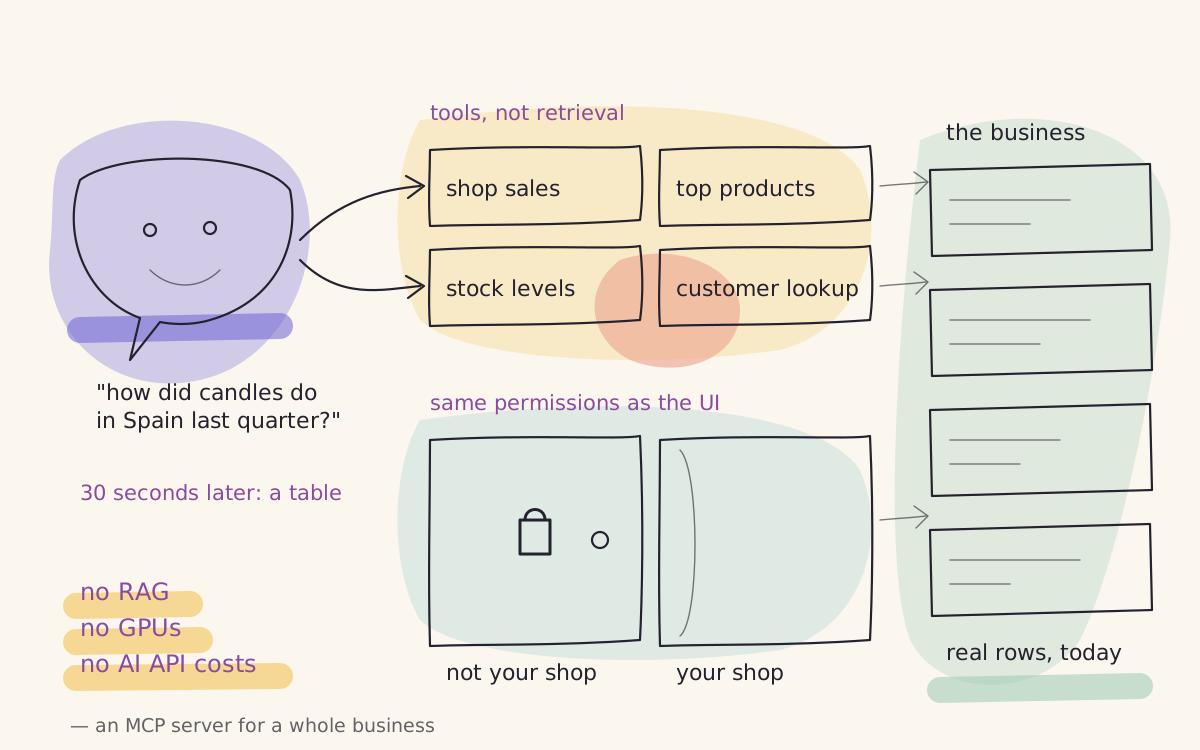
So we did not build RAG. We built tools — and gave the model the same door the staff use.
The shape
aiku ships its own MCP server. Any client that speaks the protocol — a desktop assistant, an IDE, an agent framework — connects with a personal access token and sees a list of tools: shop sales, top products, family sales, order status, customer lookup, stock levels, slow stock, warehouse performance, mailshot performance, marketing by channel, employee attendance, refunds by product… forty‑five of them. Each tool is a thin wrapper over an action class the web application already runs, returns structured data, and carries a description written for the model: what it answers, what it needs, what to call first if you do not have it. A guide served from the same endpoint says how they fit together.
The model decides which tools to call and in what order; the tools decide what it is allowed to see. That division is the whole design.
It is worth being precise about who does the work. The staff member's own assistant does the thinking — the model in their desktop client, their coding agent, their chat product. We do not run a model. We do not fine‑tune one, host one, or pay for one. What we provide is the muscle memory of the business: forty‑five well‑described tools, a guide that says which to reach for, and a door that only opens as far as that person is allowed. The model brings the reasoning; we bring the hands and the rules. When the answer is wrong, it is almost never because the model reasoned badly — it is because a tool description was unclear, and we fix the description.
That is also how the system gets smarter. Every call is logged — who, which tool, what arguments, how long, did it fail and why — and we read those logs regularly: which questions people ask, which tools they reach for first, where the model loops or gives up. A loop becomes a clearer denial message; three people asking the same thing through raw SQL becomes a new tool; a misunderstood argument becomes a rewritten description; a new question the guide did not cover becomes a line in the guide. None of it is a model update. It is the server learning to talk to its callers, one sentence at a time, and the dashboard that drives it is a page we look at every week.
Read-only, and that is a management decision
Every tool is read-only. There is no "create order", no "update price", and we do not intend to add one quietly. Giving a language model the ability to change commercial data is an authorisation question for the people who run the company, not a developer convenience. The server makes that boundary structural: a tool either reads or it does not exist.
The one exception to "purpose-built tools only" is a SQL tool, and it is gated behind a separate permission that we do not grant ourselves. When someone needs a question answered that the tools cannot, we build a tool for it. That keeps the model's reach legible.
The same permissions as the UI
Every request runs as the user who owns the token. A tool called against a shop the user cannot see in the web app returns a permission error, not an empty result — the distinction matters when an assistant is deciding whether to try a different route.
This fell out naturally because the tools are thin wrappers over the same action classes the UI uses. There is no second authorisation layer to drift.
Slugs, not names
Tools identify shops, organisations and warehouses by slug, never by display name. A model asked about "the UK shop" is told to call my-access first, which returns the slugs the user can reach, and then to use one of those. It is never allowed to guess. Guessing is how an assistant cheerfully reports numbers from the wrong entity with total confidence.
A door into the app, not a copy of it
Lookup tools for products, customers and orders return a grp_url: the full URL of that record in the staff application. If the user's assistant can drive a browser, it can go and look. We chose that over re-implementing every screen as a tool, and over sprinkling the DOM with agent-only hints.
On that last point we were deliberate. We will make the busiest pages more accessible — labels on icon buttons, proper table headers, keyboard-reachable actions — because that helps humans and agents equally. We will not add hidden data-agent-* attributes or instructions in the markup: they are visible to crawlers, they drift, and on a public storefront they are a prompt-injection surface.
What forty tools look like
A sample of the registry, by area:
- Sales — group, shop, family and product sales over any date range; top products; order funnel; refunds by product; offer performance.
- Customers — lookup, notes, conversion, email pressure (how many sends a customer has received recently, so nobody mails them a fifth time).
- Warehouse — stock levels, slow stock, warehouse performance, delivery-note summaries.
- Marketing — channel and campaign performance, mailshot performance, margin trends.
- People — employee directory and attendance, staff chat analytics.
- Meta —
my-access,describe-tables(for SQL users), and the tool that tells the model how to use the others.
Each tool's description is written for the model, not for us: what it returns, what it needs, and what to call first if you do not have it.
A guide in the server, not in the client
We also serve an llms.txt-style guide from the same endpoint: house rules for tone when the assistant drafts customer replies, the data-protection rules about customer ids, the things staff must never paste into a chat. Putting the rules next to the tools means every client gets the same ones.
What happened when people used it
Reactions came in a predictable order.
First, disbelief. A manager typed a question they had been asking for years — which families in which shop were down against last year, with margins — and got a table back before they had finished reading their own question. The first response, from more than one person, was some version of "how can it be telling me this?" A few quietly went and checked whether the numbers were random. They were not. They were the figures from the same rows the dashboards read, and they matched.
Then, the questions nobody would have dared put in a ticket. A sales question is one thing; the tools also answer the kind of question that used to need a consultant. Someone asked: "Looking at what we actually pick, how should we rearrange the stock locations in this warehouse so picking walks are shorter?" The assistant pulled the picking history by location and by item, the routes, the quantities, worked out which fast‑moving items sat at the far end of the racks and which slow ones occupied the prime bays by the packing bench, and proposed a move list — what to swap with what, and why. The warehouse tried it. It worked: the walks got shorter, measurably. Other people have asked for the customers most likely to lapse next month from their ordering rhythm, for which families carry the stock that has not moved in a year and what it is worth, for the mailshots whose clicks turned into orders and the ones that only produced unsubscribes. None of those are tools. They are tools combined, by a model that was told what each one does and allowed to think.
Then, the arithmetic of time. A report like that used to be: three people, most of a day, if they were lucky and the spreadsheets lined up; or a ticket to engineering, which meant days and a place in a queue. It is now thirty seconds away, for anyone with the permission to see the underlying data, in their own words, as many times as they like, at ten at night if that is when they think of it. The same assistant can then open the record in the staff app, because the tools hand it the URL.
Then, the god‑like users. For the handful of people with group‑wide access — the directors, the group admin — the assistant is a view over everything: every organisation, every shop, every warehouse, every customer, every invoice and every stock movement since the beginning, across the whole database — roughly three hundred gigabytes of operational history — in one question, compared any way they like. Not a dashboard someone built for them last year; the entire business, live, answering in their own words. They had never had that, because no one could build a screen wide enough. And the reason they can have it is the same reason a picker cannot: access is wired to the user's permissions, and managers have total control over who sees what. Grant a job position and the assistant sees that much; take it away and it goes. Nothing is configured in the AI layer; it is the same switchboard HR already operates.
Then, the split. Some people were afraid of it and still are — of the speed, of being wrong in front of it, of what it means for work they used to do by hand. Some embraced it on day one and have not opened a spreadsheet since. Most are somewhere in between and drifting toward the second group. We did not push; we watched the usage and fixed what the log told us was confusing.
And, the bill. There is no API cost on our side. The server exposes tools; the model runs in whatever assistant the staff member already uses — a desktop AI client, a coding agent, a chat product — on that person's own subscription. We do not pay per token, per question or per seat; we pay nothing. A company‑wide analytics capability that would have been a six‑figure project and a line on the budget every year is a route and forty‑five classes. That, as much as the thirty seconds, is the game‑changer.
It is, honestly, the closest thing to magic we have shipped. Not because the model is clever — it is — but because for the first time the distance between a question about the business and its answer is the length of the question.
What we learned
The tools were never the hard part. The hard parts were: deciding in advance what the model may not do, making wrong entities impossible to reach by accident, and writing descriptions a model actually follows. Everything else was a week.